Welcome to the start of your hands-free journey! Babywearing is a wonderful tool for bonding, calming a fussy baby, and navigating daily life in the Philippines. However, safety is non-negotiable. Whether you use a soft structured carrier, a ring sling, or a woven wrap, there are two golden rules you must master: the T.I.C.K.S. Rule (for airway safety) and the M-Position (for hip health).
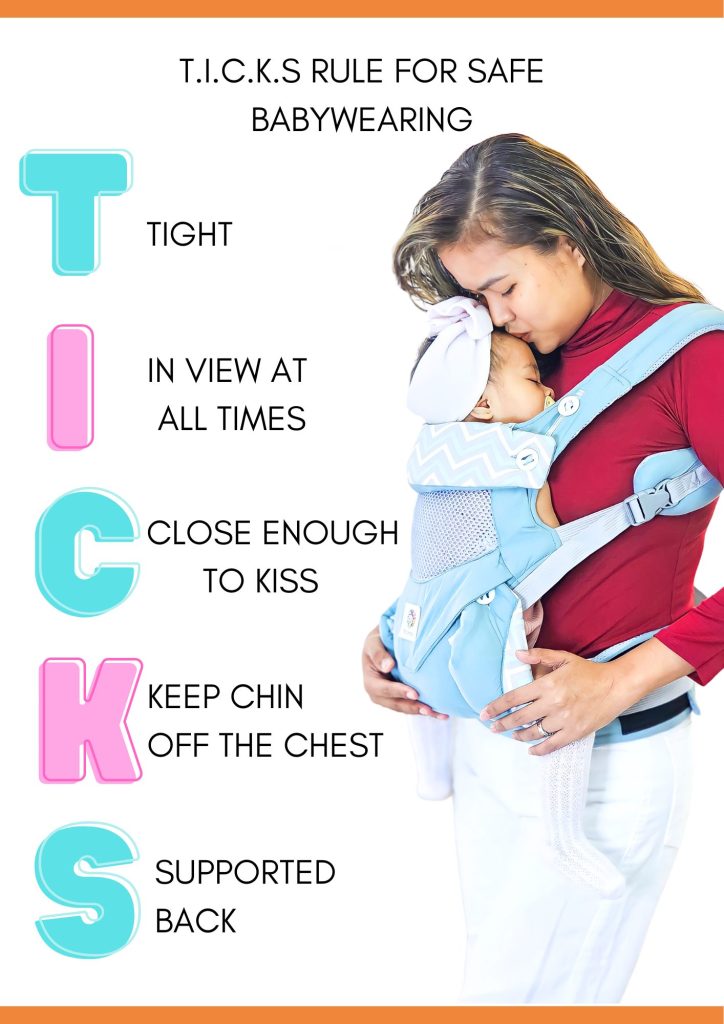
1. T.I.C.K.S. Rule: The Airway Safety Checklist
The T.I.C.K.S. rule is the international standard for preventing positional asphyxia (suffocation) and ensuring your baby can breathe freely at all times. Check all five points every time you put on a carrier.
The carrier should be snug, hugging your baby close to you. If the carrier is too loose, the baby can slump down, curving their chin to their chest and restricting their airway.
You should always be able to see your baby’s face by simply glancing down. Fabric, clothing, or your body should never cover their nose or mouth.
Your baby should be positioned high enough that you can easily tip your head forward and kiss the top of their head or forehead. This height ensures they are not sitting too low, which can compress the airway and strain your back.
Ensure there is always a gap under your baby’s chin. When a baby’s chin is forced onto their chest, it can close off their windpipe. This is especially dangerous for newborns who lack head control.
Your baby’s back should be supported in its natural “C-curve” (for newborns) or slightly upright position, with their tummy against you. If the carrier is loose, they can slump or curl over, which affects both breathing and spinal development.
2. 🦴 The M-Position: Protecting Developing Hips
The M-Position (or Frog Position) is recommended by the International Hip Dysplasia Institute (IHDI) to promote healthy hip development. When a baby is carried in this position, their hips and knees are bent, and the hip joint is centered in the socket.
How to Check for the M-Position:
- Knees High: Your baby’s knees should be slightly higher than their bottom.
- Thigh Support: The carrier panel must support your baby’s thighs from knee-to-knee.
- Spread: The legs should be spread naturally around your torso, creating the “M” shape (where the knees form the two outer points and the bottom forms the center dip).
Crucial Tip: Carriers that allow a baby’s legs to dangle straight down without proper knee-to-knee support can place undue stress on the hip joints. Always check for that supportive “M” shape!
Your Confidence Starts with Safety
Mastering the T.I.C.K.S. rule and the M-Position isn’t about being perfect; it’s about being prepared and confident. Every time you check these two rules, you are making a conscious choice to prioritize your baby’s safety and healthy development. This is what intentional parenting looks like!
Now that you know the how-to of safety, your next step is finding the perfect gear to make your babywearing comfortable, secure, and cool enough for the Philippine heat.
Ready to find your perfect carrier?
Click here to read Part 2: Choosing the Right Carrier for the Philippine Climate & Lifestyle, where we dive into fabrics, styles, and local brands like Shadrach.co to guide your purchasing decision.
 MilkMates PH
Leave a comment